

If you are looking for an agency to manage your advertising, you will quickly come across terms such as PPC agency, paid media agency and performance marketing agency. They can sound like different names for the same thing, but they are not quite the same.
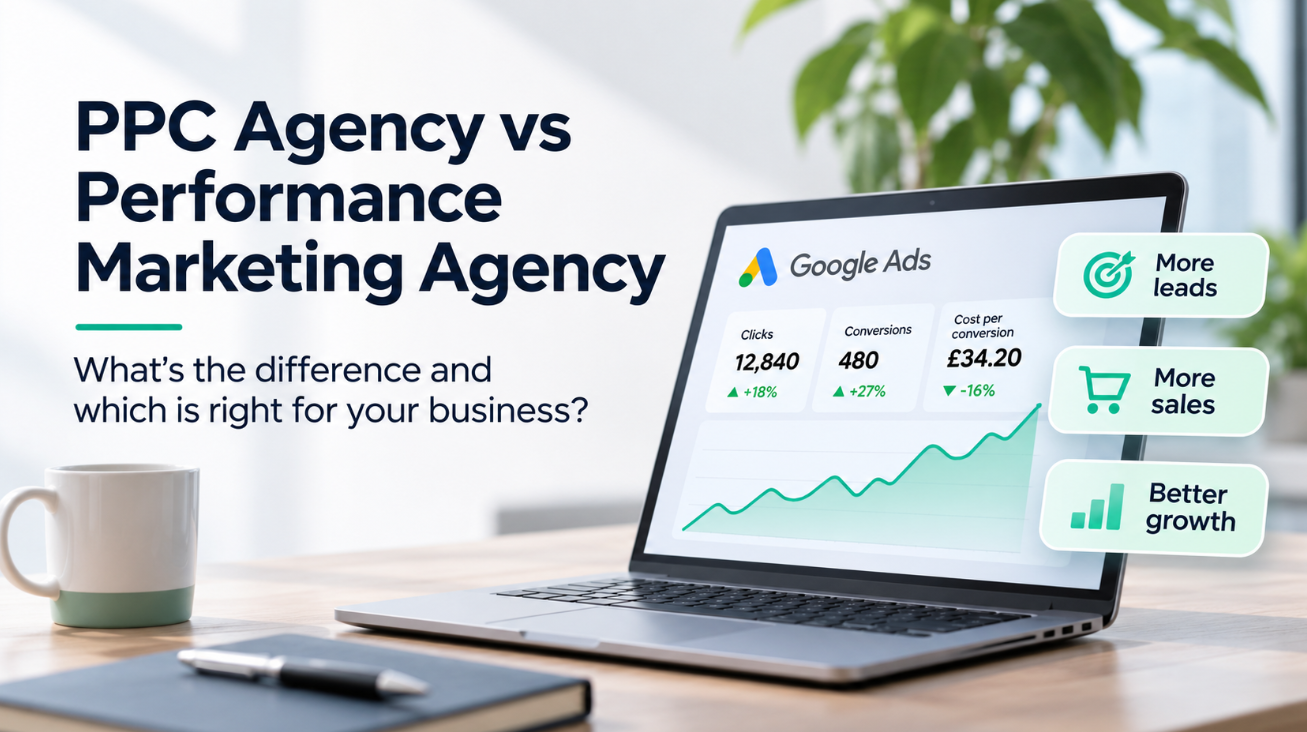
A PPC agency usually focuses on managing paid advertising campaigns, particularly platforms such as Google Ads and Microsoft Advertising. A performance marketing agency takes a wider view. Paid advertising may still be a major part of the strategy, but the focus is not only on clicks, conversions or campaign performance. It is also about what happens after someone clicks an advert.
Are those clicks turning into genuine leads? Are those leads becoming customers? Is the advertising generating enough revenue to justify the spend?
That difference matters. A Google Ads campaign can bring the right people to your website, but if the landing page is poor, the tracking is inaccurate or the leads are low quality, improving bids and keywords will only get you so far. This is where the difference between PPC management and performance marketing becomes important.
What Does a PPC Agency Do?
PPC stands for pay-per-click. In simple terms, advertisers pay when someone interacts with an advert, usually by clicking it.
Google Ads is the platform most people associate with PPC, although paid search can also include Microsoft Advertising and other platforms. A PPC agency will normally manage areas such as campaign structure, keywords, bidding, ad copy, targeting, budgets, negative keywords and conversion tracking.
A good PPC agency should also be regularly reviewing performance and making changes. PPC campaigns are never really finished. Search behaviour changes, competitors change their offers, costs move up and down, and new search terms appear over time.
Some keywords perform better than expected while others waste money. A strong agency should be responding to that data and adapting the account accordingly.
The limitation is that PPC only covers part of the customer journey. An advert can do its job perfectly and still fail to generate business if the experience after the click is poor.
What Is a Performance Marketing Agency?
A performance marketing agency looks beyond the advertising platform itself. The goal is not simply to generate more traffic or reduce the cost of a click. The aim is to understand whether the marketing activity is producing a useful commercial result.
For one business, that might mean more online sales. For another, it could mean qualified enquiries, bookings, memberships or new customers. The exact outcome changes from business to business, but the principle stays the same.
Performance marketing connects marketing activity with measurable business results.
A performance marketing agency may still manage Google Ads, Meta Ads, LinkedIn Ads and other paid channels. The difference is that it should also be thinking about what happens before and after the click.
Is the right audience seeing the advert? Does the advert match what they are looking for? Does the landing page make sense? Is the conversion tracking accurate? Are the enquiries actually useful?
These questions move the conversation away from simply managing an advertising account. The focus becomes improving the full journey from advertising spend to business result.
PPC Agency vs Performance Marketing Agency
The easiest way to understand the difference is to look at what each one is trying to improve.
A PPC agency will usually focus heavily on the advertising campaign itself. A performance marketing agency will also look at the campaign, but it should consider how that campaign affects the wider customer journey.
Imagine a business spends £8,000 per month on Google Ads and generates 100 enquiries. On paper, that gives a cost per lead of £80, which may look strong.
But what if only 15 of those enquiries are genuinely relevant?
The picture changes very quickly.
If the business only focuses on reducing the £80 cost per lead, it could end up pushing the campaign in the wrong direction. Cheaper leads are not always better leads.
A performance-led approach would look deeper. Which campaigns generated the best enquiries? Which search terms brought in poor-quality leads? Which locations performed best? Which landing pages helped turn visitors into customers?
The goal is not to make the advertising dashboard look better. The goal is to make the marketing work better for the business.
More Leads Do Not Always Mean Better Performance
Lead volume is one of the easiest numbers to focus on in paid advertising. It is also one of the easiest to misunderstand.
Imagine one campaign generates 50 leads at £40 each, while another generates 25 leads at £70 each. At first, the first campaign looks much stronger.
However, if the cheaper leads rarely turn into customers while the more expensive leads convert regularly, the second campaign may be far more valuable.
This is why performance marketing should look beyond the initial conversion. For lead generation businesses, it is important to understand what happens after someone fills in a form or makes a call.
How many leads were genuine? How many became sales opportunities? How many eventually became customers?
Those answers often tell you more than cost per lead on its own.
The same applies to eCommerce. A campaign can show a strong return on ad spend but still be less profitable than expected if it is selling low-margin products or attracting customers who only buy once.
Marketing data needs context. Without it, even good-looking numbers can be misleading.
Your Website Is Part of Paid Media Performance
Paid advertising does not stop when someone clicks. The website has to do its job as well.
You could have excellent targeting, strong adverts and competitive bids, but if the landing page is confusing, slow or difficult to use, people may still leave without taking action. At that point, sending more traffic to the page is unlikely to solve the real problem.
This is where conversion rate optimisation, often called CRO, becomes important.
Sometimes the biggest opportunity is not another keyword or another campaign. It is improving what happens to the traffic you already have.
That might mean simplifying a form, making the main call to action clearer, improving the mobile experience or making the landing page better match the advert that brought the visitor there.
Small changes can make a meaningful difference. If more of your existing visitors become customers, you may be able to grow without increasing your advertising budget at the same rate.
Tracking Matters More Than Many Businesses Realise
There is another problem an agency cannot solve simply by changing bids or keywords: poor tracking.
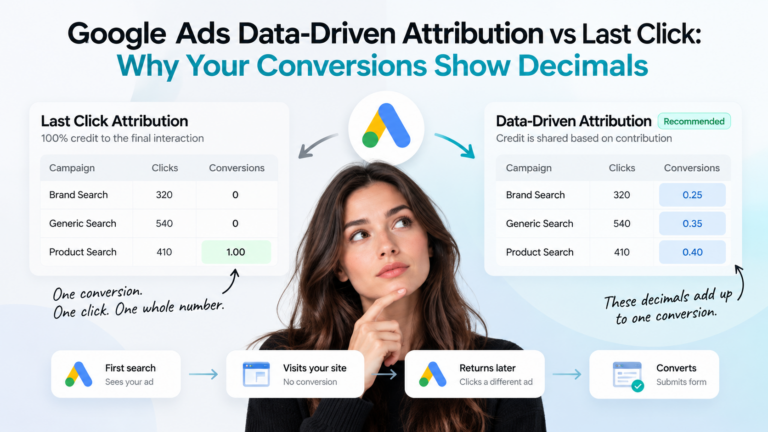
Advertising platforms rely on the conversion data they receive. If that data is wrong, the decisions being made from it may also be wrong.
For example, a business may accidentally count several small actions as important conversions. Google Ads could then start optimising towards those easier actions, even if they have little commercial value.
The campaign may report more conversions while sales stay exactly the same.
This is why accurate tracking is such an important part of performance marketing. Google Ads, GA4, Google Tag Manager and CRM data can all play a role.
The aim is not to collect as much data as possible. The aim is to collect the right data and use it to make better decisions.
A useful report should help you understand where your customers are coming from, what you are spending to acquire them and which campaigns are creating value. It should also make wasted spend easier to identify.
If reporting cannot help answer those questions, adding more dashboards will not solve the problem.
Where Does a Paid Media Agency Fit In?
You may also come across the term paid media agency.
A paid media agency usually manages advertising across several paid platforms. That may include Google Ads, Meta Ads, LinkedIn Ads, YouTube and other channels.
For many businesses, that is useful because customers do not spend all of their time on one platform. However, simply running more channels does not automatically create a performance marketing strategy.
A business could be advertising on Google, Meta and LinkedIn at the same time and still have weak tracking, poor landing pages and no clear idea of which activity is generating revenue.
The number of platforms is not the important part. What matters is how those platforms work together and what the business is measuring.
A strong paid media agency should therefore have a performance mindset, even if paid advertising remains its main service.
When Does a PPC Agency Make Sense?
There are situations where a specialist PPC agency may be exactly what a business needs.
If Google Ads is your main source of new customers and the rest of your marketing journey is already working well, specialist PPC management can be highly effective. You may not need a complicated multi-channel strategy.
You may simply need an experienced team to improve campaign structure, reduce wasted spend, find new opportunities and manage the account properly.
The important thing is knowing what problem you are trying to solve.
If the main problem sits inside the advertising account, PPC expertise may be enough. If the problem extends beyond it, a wider performance marketing approach is often more useful.
When Should You Consider a Performance Marketing Agency?
A performance marketing agency becomes more valuable when the problem is not limited to one advertising platform.
Perhaps Google Ads is generating leads, but the quality is inconsistent. Maybe Meta Ads is bringing plenty of traffic but very few customers. You might have several agencies or freelancers managing different channels, with nobody looking at the overall picture.
You may also have reached the point where increasing advertising spend is no longer producing the same level of growth.
These situations usually need a wider view.
The solution may involve paid media, but it could also involve better tracking, a stronger landing page, different audience targeting or moving budget between channels.
A good performance marketing agency should try to find the real problem before recommending more spend.
What Should You Expect From a Performance Marketing Agency in the UK?
The word performance is used by a lot of agencies, so the label alone does not tell you very much.
What matters is how the agency actually works.
A performance marketing agency should be able to explain what success looks like before campaigns begin. That should go beyond impressions, clicks and traffic.
For an eCommerce business, success might be based on revenue, customer acquisition cost and profitability. For a B2B company, qualified leads, cost per opportunity and pipeline value may be more useful.
You should also expect transparency.
You should know where your advertising budget is going, what is being changed and why those changes are being made. Reporting should make performance easier to understand, not harder.
The strategy should also change as the data changes. Performance marketing is not something that is set up once and then ignored.
It requires testing, learning and regular improvement.
Should You Choose a Google Ads Agency, PPC Agency or Performance Marketing Agency?
The answer depends on what you need help with.
If Google Ads is the main issue, choosing an experienced Google Ads agency or PPC agency can make sense. If you are advertising across several paid platforms, a paid media agency may be more suitable.
If the bigger challenge is turning your overall marketing budget into more customers and revenue, a performance marketing agency is likely to be a better fit.
There is plenty of overlap between these agency types.
A PPC agency may also manage paid social. A paid media agency may describe itself as a performance agency. A performance marketing agency may have particularly strong Google Ads expertise.
The name is not the most important part.
The approach is.
Before choosing an agency, find out what they measure, how they report performance and how often campaigns are reviewed and improved.
Most importantly, understand what happens when the real problem sits outside the advertising account. Those answers will usually tell you far more than the label on the agency’s website.
Performance Marketing Goes Beyond Managing Ads
Businesses do not invest in marketing because they want more clicks. They invest because they want growth.
Clicks, impressions, conversion rates and cost per lead are useful numbers because they help explain what is happening. But they are not the final goal.
A strong performance marketing strategy connects those numbers back to the outcomes that matter to the business.
That changes the questions being asked.
Instead of asking how to get more clicks, the focus becomes how to acquire more of the right customers. Instead of asking how to generate cheaper leads, the focus becomes understanding which leads actually become revenue.
That is a simple change in thinking, but it can lead to much better marketing decisions.
A Performance Marketing Agency Focused on Commercial Growth
At Mass Reach, paid media remains a major part of what we do. We manage campaigns across Google Ads, Meta Ads, LinkedIn Ads and other channels, but campaign management is only one part of the picture.
We also look at what happens around those campaigns. That includes conversion tracking, landing page performance, lead quality, reporting and how advertising contributes to wider commercial goals.
For some businesses, the biggest opportunity is inside the Google Ads account. For others, it may be somewhere else in the customer journey.
The important thing is identifying where performance is being lost before simply increasing the budget.
That is the difference between running advertising and managing performance.
Looking for a Performance Marketing Agency in the UK?
If you are already investing in paid media but are unsure whether your campaigns are producing the results they should, it may be worth looking beyond the headline numbers.
Mass Reach works with businesses across the UK to improve Google Ads, paid media, conversion performance and marketing measurement around clear commercial goals.
Whether the challenge is wasted advertising spend, poor-quality leads, low conversion rates or uncertainty around what is actually working, the first step is understanding where performance is being lost.
Speak to the Mass Reach team to arrange a strategy call and take a closer look at how your marketing is performing.
Frequently asked questions
Look for an agency that can clearly explain how it measures success, how often campaigns are reviewed and how it connects marketing activity to real business outcomes.
A strong agency should also be transparent about where your budget is going, what changes are being made and why. Reporting should help you understand performance rather than simply showing you a long list of metrics.
There is no single minimum budget that works for every business. The right level depends on your industry, location, competition, average customer value and what you are trying to achieve.
What matters more is whether there is enough budget to gather useful data and make meaningful improvements. If most of the budget is being spent on agency fees rather than media, it may be worth reviewing whether paid advertising is the right channel at that stage.
Yes, particularly when lead quality can be linked back to the campaigns, audiences, keywords and landing pages that generated those enquiries.
This may involve improving conversion tracking, reviewing search terms, adjusting targeting or feeding CRM data back into the advertising strategy. The aim is not simply to generate more leads, but to generate more of the leads that are likely to become customers.
Do not judge performance purely on clicks, impressions or even cost per lead.
Look at whether the agency is improving the quality of traffic, reducing wasted spend, generating relevant enquiries and helping the business achieve better commercial results over time.
You should also understand what the agency is changing and why. If performance reports are difficult to interpret or discussions never move beyond surface-level metrics, that can be a warning sign.
No. A lower cost per lead can look positive, but it does not tell you whether those leads are useful. A campaign generating £30 leads that rarely become customers may be less valuable than one generating £60 leads that regularly convert into sales.
Cost per lead should therefore be considered alongside lead quality, sales conversion rates and customer value.
Yes. Google Ads is often a major part of performance marketing.
The difference is that a performance marketing agency should not look at Google Ads in isolation. It should also consider areas such as landing page performance, conversion tracking, lead quality and how Google Ads contributes to wider commercial goals.
It may be time to review your agency if communication is poor, reporting lacks clarity, campaigns are rarely updated or there is no clear strategy behind the work.
Another warning sign is when the conversation focuses only on clicks, impressions and lead volume without considering sales, revenue or lead quality.
You should be able to understand what your agency is doing, what is working and what the next priorities are.
Yes. Many performance marketing agencies work alongside internal marketing teams rather than replacing them.
The agency may focus on paid media, tracking, optimisation and strategy, while the internal team handles areas such as content, brand, sales enablement or wider marketing activity.
The best setup depends on the skills already available within the business.